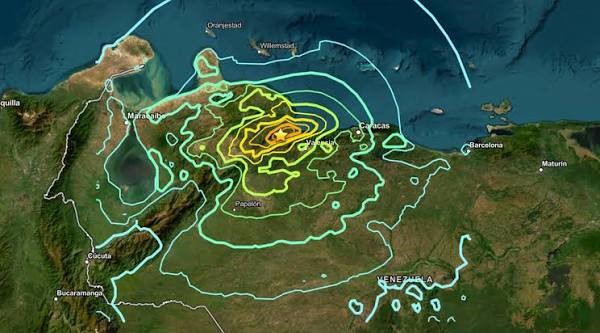
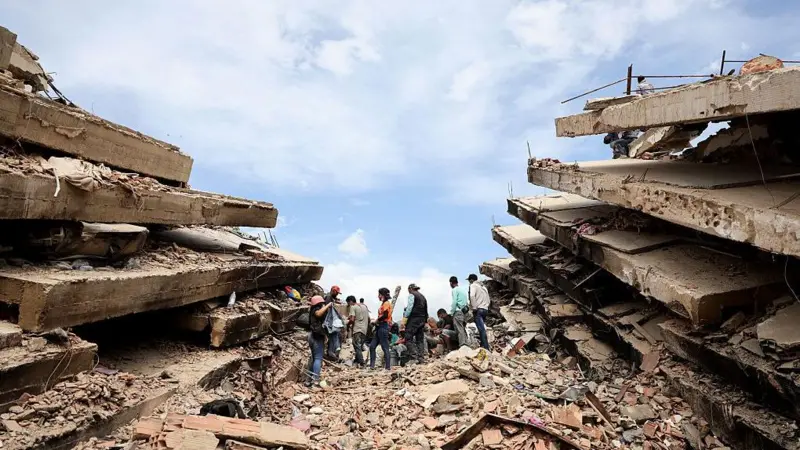
Venezuela was struck on June 24 by two consecutive earthquakes of magnitudes 7.2 and 7.5, separated by less than one minute and at a depth of 10 km. The earthquakes caused building collapses, structural damage, communication disruptions, and the collapse of part of the infrastructure, paralyzing much of the economic activity. The state of La Guaira was the most affected area, as the epicenter and the strongest impact of both seismic events were concentrated there.
Emergency response efforts have included the participation of civilian volunteers searching for their relatives, friends, neighbors, or anyone who may have been trapped under the rubble, as well as the deployment of army personnel and security forces. At the same time, a large international humanitarian operation was activated, with search and rescue teams and assistance from multiple countries, including the United States, Mexico, Colombia, Chile, Argentina, Brazil, Canada, Spain, Italy, France, Germany, Russia, China, India, and Japan, which are collaborating in search operations, medical care for the injured, and logistical support in the most affected areas.
According to the report issued this Sunday by the President of the Venezuelan Parliament, Jorge Rodríguez, the death toll has risen to 3,342 people, while more than 31,000 remain missing. In addition, 6,462 people have been rescued and 17,345 have lost their homes, leading to the establishment of 79 temporary camps. Rodríguez also reported via Telegram that 856 buildings remain damaged and 190 have completely collapsed.
The catastrophe occurs in a context of a severe crisis in Venezuela. The country had already experienced bombings during a coup d’état and the kidnapping of its president by the United States, with the aim of controlling its oil resources and securing a strategic position in Latin America. It is now struck by two earthquakes that further push it toward collapse. Venezuela possesses one of the largest oil reserves in the world and the resources necessary to be one of the richest countries, and this blow is described as equivalent to having received hundreds of missiles over the city, recalling images of recent destruction and genocide in Gaza by Israeli forces, largely with weapons supplied by the United States.
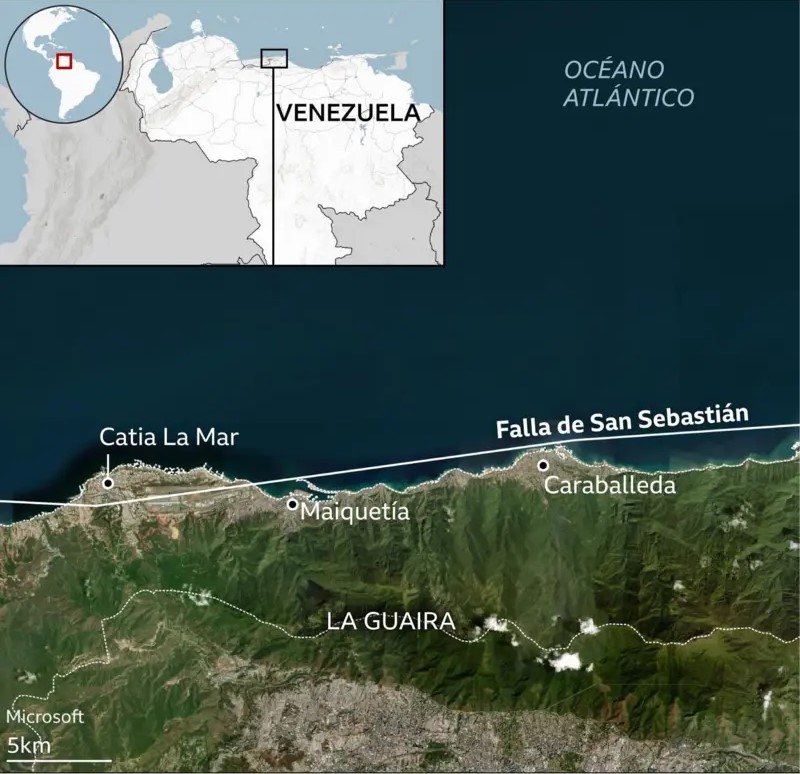
Regarding the origin of the earthquakes in Venezuela, the explanation offered by many geologists is that they are due to the movement of the South American tectonic plate in relation to the Caribbean plate, which generated a massive release of energy from deep within the Earth, with its peak impact occurring off the northern coast of Venezuela, with the state of La Guaira as the main affected area.
Part of the San Sebastián Fault runs off the coast of La Guaira
 Simplified model of the fault. Source: Global Earthquake Model Foundation.
Along with this explanation, other hypotheses have also emerged that suggest the possibility that some large-scale phenomena can be induced with military technologies such as HAARP, which operates with low-frequency wave vibrations that affect the heat of the ionosphere, as well as underground bombs and other methods that could potentially exploit the same force of nature to cause disasters. The fact that two consecutive earthquakes occurred, of similar magnitudes, separated by less than one minute and at a depth close to 10 kilometers, has been described as an event of extremely low probability and is considered a statistically exceptional event. In 2023, a similar double earthquake was also recorded in Turkey and Syria in terms of magnitude and depth. Regarding the 2010 Haiti earthquake, Hugo Chávez denounced that it may have been caused by the United States through the use of ionospheric heaters. In addition, the CIA itself has admitted in declassified official documents that they have used climate weapons in Vietnam, Cambodia and Laos. In the last decade, intentional forest fires have also been reported in Spain, Chile, California, Maui, Jamaica and other places around the world. Likewise, it has been claimed that Iraq was subjected to an induced drought through U.S. military radar systems, while in 2026, after the destruction of U.S. military installations in the war in Iran, the rains returned and the rivers and reservoirs filled again for the first time in twenty years.
According to these backgrounds, it would seem that some disasters respond to geopolitical interests. Is it possible to induce and take advantage of the forces of nature to generate natural disasters as described above? This is known as military geoengineering and began to be used more extensively at the beginning of the 20th century. Today it has reached a high level of development and forms part of what is known as hybrid warfare: a type of attack in which the public is not necessarily aware that it is being attacked, or does not know who is actually responsible. At the same time, the media emphasizes messages related to the environment, while sectors of the financial system promote taxes under the pretext of climate, restrictions on development, new control technologies, and financing programs that increase countries’ debt in order to face reconstruction after a crisis or a disaster, regardless of its origin.
The priority is for Venezuela to overcome the consequences of this disaster in order to face one of the greatest emergencies in its recent history.