Written by
Jorge S. Adedo Rovirosa
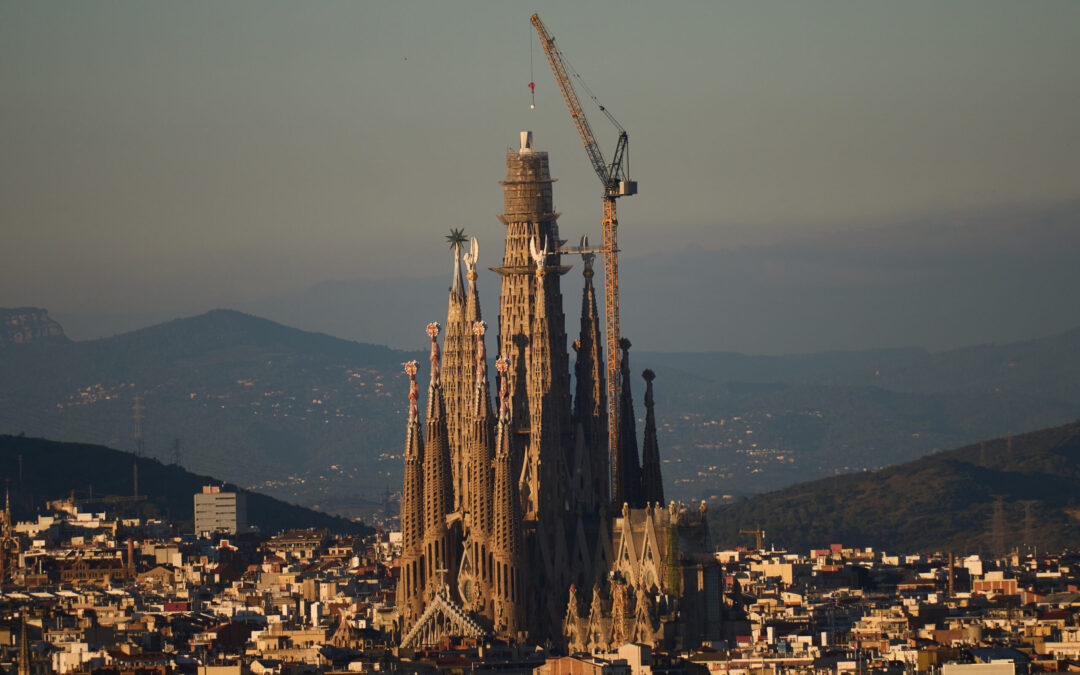
In the heart of Barcelona stands the Basilica of the Sagrada Familia, a work that transcends traditional religious architecture to become a living experiment in form, light, and nature. Conceived by the Catalan architect Antoni Gaudí, the basilica remains under construction more than a century after its inception, making it one of the longest-running and most fascinating architectural projects in modern history.
Origins and History of an Unfinished Masterpiece
Construction of the Sagrada Familia began in 1882, initially following a Neo-Gothic design promoted by architect Francisco de Paula del Villar. However, in 1883, Gaudí took over the project and radically transformed it, moving away from the original scheme to create a unique synthesis of spirituality, geometry, and nature.
Gaudí devoted the final years of his life exclusively to the temple, fully aware that he would never see its completion. He died in 1926, leaving only part of the Nativity Façade and several towers completed. Since then, construction has continued intermittently, financed primarily through donations and visitor contributions.
During the Spanish Civil War, part of the original plans and models were destroyed, forcing later generations of architects to reinterpret Gaudí’s vision from surviving fragments and reconstructed models.
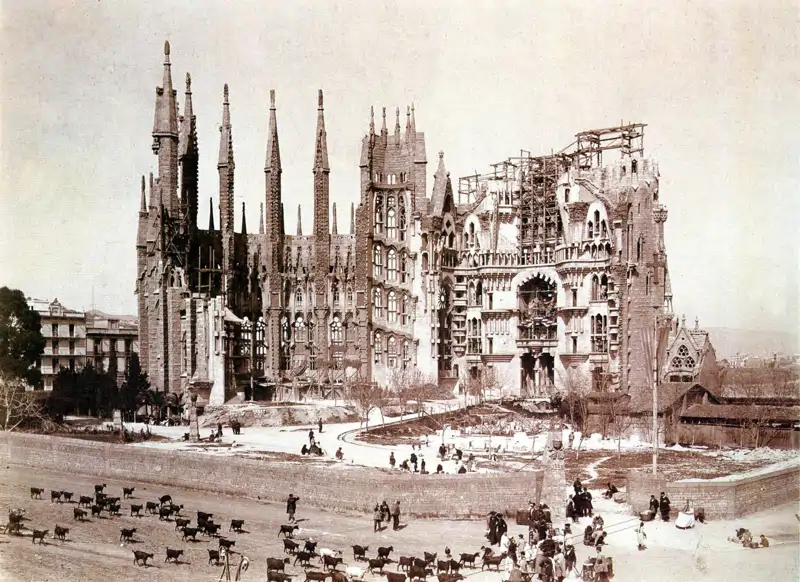 Construction of the Sagrada Familia in 1900.
An Architecture That Translates Nature
The Sagrada Familia does not seek to imitate nature; rather, it translates nature’s underlying principles into architectural structure.
Inside, the columns are not static elements. They branch like trees reaching upward toward the light. The vaults spread out like the canopy of an interior forest, filtering illumination throughout the day as though sunlight were passing through real foliage.
Stone, far from appearing heavy or rigid, takes on an organic quality. The geometry is based on natural forms—tree trunks, shells, helices, and fractals—creating a structural system that eliminates the classical rigidity of traditional architecture.
The result is a space in which human beings do not confront the building but become part of a constructed, almost biological ecosystem, where light, form, and material work together to create an environment that feels inherently natural.
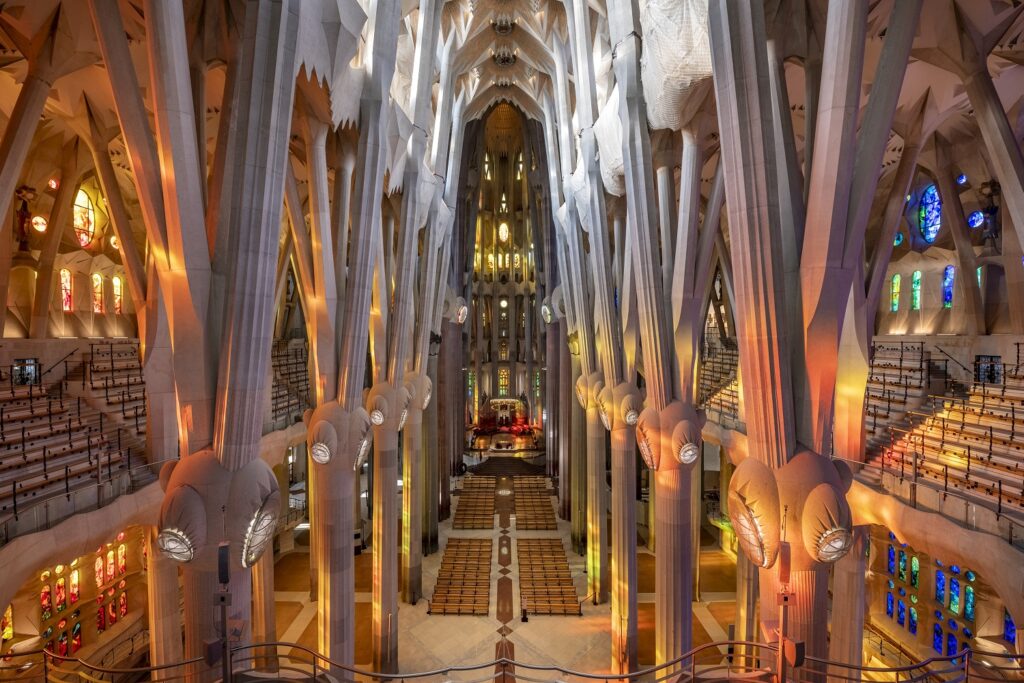 Detail of the central nave viewed from the Glory Choir Loft. Photograph: Pep Daude.
Construction Process: Centuries of Evolution
Over time, the construction of the temple has passed through several stages:
- 1882–1926: Gaudí’s period, during which the conceptual framework was established and the Nativity Façade, located on the northeast side (Marina Street), was constructed.
- 1926–1936: Limited continuation and reinterpretation of the surviving plans.
- 1936–1939: Partial destruction during the Spanish Civil War.
- 1950–2000: Gradual reactivation of the project with the introduction of new technologies.
- 2000–present: Accelerated progress through digital modeling and technology-assisted construction methods.
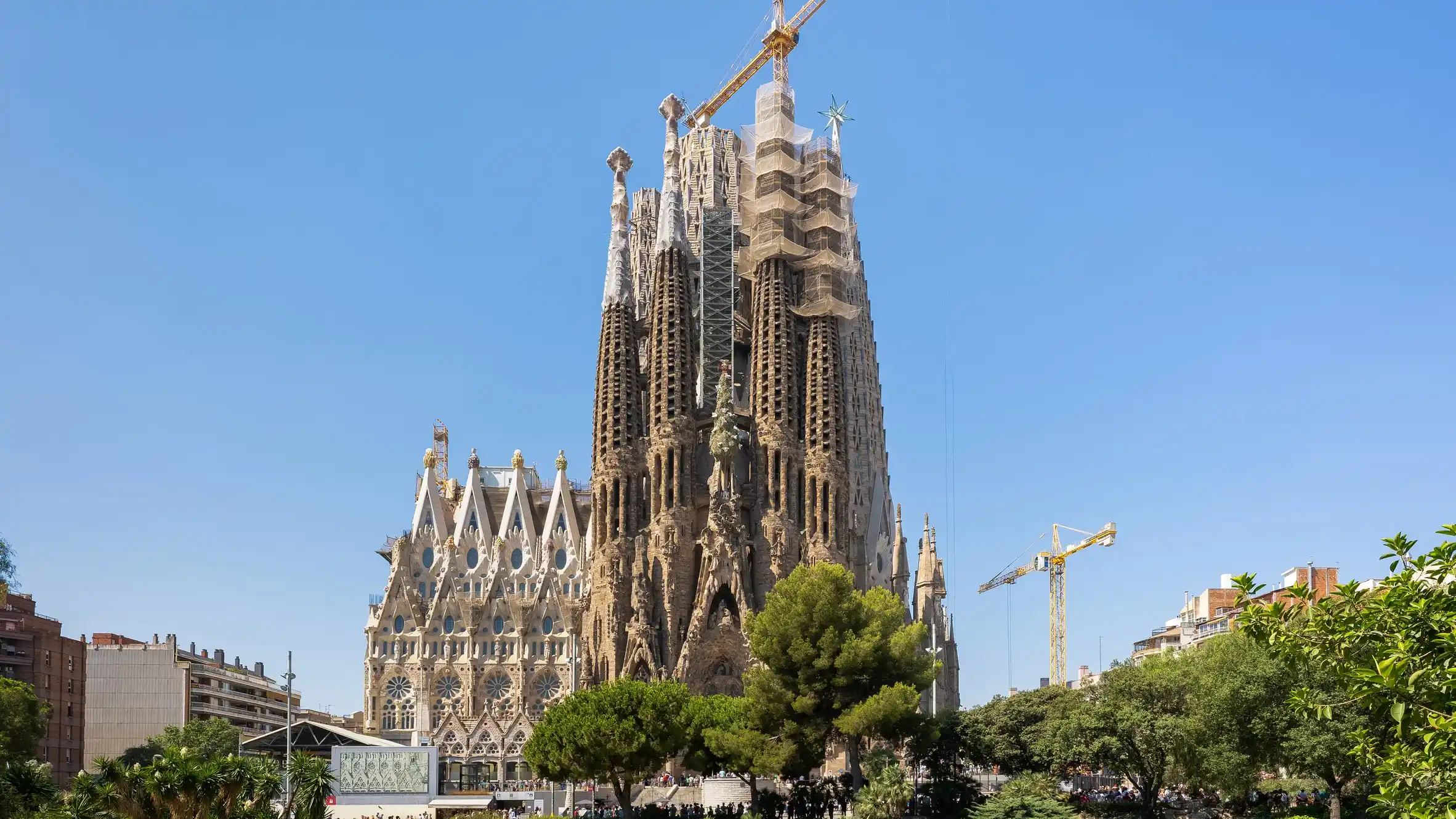
In recent decades, advancement has been particularly significant in the central towers. Today, the project has entered its final phase of structural construction.
Current Status in 2026 and What Comes Next
In 2026, the Sagrada Familia reaches a decisive milestone with the completion of the Tower of Jesus, the tallest structure in the complex, which concludes the temple’s main structural phase and definitively defines Barcelona’s skyline.
From that point forward, the project enters its final stage: work continues on the tower’s interior finishes, sculptural details, and construction adjustments throughout the temple complex. At the same time, the construction of the Glory Façade remains pending. As the main entrance and one of the most complex elements of the project, it will extend construction for several more years.
Rather than an immediate conclusion, 2026 marks a transition: the shift from a phase of vertical growth to a more precise stage of completion, in which Gaudí’s vision is brought to fruition after more than a century of continuous evolution.
Inspiration: A Living Architecture
The Sagrada Familia is inspired by the idea that nature is not static, but rather a system in constant growth. Gaudí understood architecture as an extension of that principle: a structure that does not impose itself on its surroundings, but instead reinterprets them.
Light plays an essential role. It is not a decorative element, but a construction material. It changes, filters through the space, becomes colored, and transforms the interior of the temple just as it would in a real forest throughout the day.
More than a church, the Sagrada Familia is an ongoing exploration of how architecture can behave like a living organism.